Total Pageviews

Sunday, October 16, 2011

Busting On Bursts

Over the last week I’ve focused on trying to smooth the transition from short bursts to a continuous scale. First I warmed up with continuous alternation at 84. After this, I began with the following at 100:

When that felt comfortable, I then tried this at the same tempo:

Then finally I moved to a continuous scale, also at 100:

Obviously the idea is to gradually shorten and then remove the pauses between each one-string burst. My goal is to reduce the tension in short bursts, so that I can lengthen them into longer passages. On some days, I was able to lightly play the continuous scale at 112—one day I managed to barely hit 120. My goal, however, is to hit this cleanly and consistently, not hit or miss. So there’s much yet to be done.

As I did these exercises, I listened closely to my rhythm. I wanted each burst to snap sharply and cleanly. But more important, I was also very alert to these signs of excess tension:
  • a tight feel in a and c
  • a and c become rigidly extended or flexed
  • clenching teeth
  • tensing or hunching right shoulder
  • labored breathing

Working this way, I’ve noticed my descending six string scale tends to hang up on the second and third strings. Once I get to the fourth string, it’s smooth sailing the rest of the way. In fact, right now I can pretty consistently hit 120 on the three bass strings. At first I suspected that since the third string is the only one that has two notes, this might be the reason for my awkwardness. But I’ve no problem slurring the full six string scale at a high speed with the left hand alone. So I’m guessing this is a right hand crossing problem. Obviously I’ll spend more time working to smooth out this part of the scale.

•                              •                              •

On an unrelated note, I was surprised by some of the reactions to my last post. In this post, I drew attention to a left hand positioning suggestion that was, I thought, so obviously bad that there should be little debate over it. Oy, what a can of worms that opened! More on this in next week’s post.


——[My next update will be October 24, 2011]—— 

Sunday, October 9, 2011

120 or Bust

First things first. I soon realized I was playing part of the Mozart excerpt wrong and corrected it. After relearning it, I finally checked the score. My revised version is correct—hey, I even got the key right. Though to be honest, if asked to write it out, I’d have written in common time, so I’d have gotten the time signature wrong. Anyway, here’s the corrected excerpt:
My apologies to Mozart and his fans (of whom I’m one) for playing it wrong on my October 2 video.

This last week I stayed with the two exercises shown on the video. In the scale with the three string burst, I occasionally managed a tempo of 120. Anything above 120 invariably fell apart. The Mozart excerpt crept up to 84.

It occurred to me that, temporarily, I should lower my sights a bit and try a more attainable goal. I’ve decided to shoot for 120—first with a three string burst, then longer until I can do a continuous six string scale cleanly and reliably. So my specific goal is this at 120:
The repeat is an important part of my goal. I want to be able to do an extended scale at 120, not just a burst. If I can, then it’ll mean I’m well on my way to reducing my right hand tension during speed. I’ve also found over the years that descending scales feel easier to me than ascending scales. So my target scale must include extended ascending passages.

Why lower my goal to 120? I’m taking to heart something I’ve heard concert artist Jason Vieaux tell his students. He strongly advocates when learning a difficult passage that one should start slow and gradually work up the tempo one metronome notch at a time. One shouldn’t leapfrog over intermediate tempos. His reasoning is thus: At slower tempos, a particular problem might not be apparent. If you increase tempo gradually, you’ll eventually hit a tempo at which the problem just begins to be apparent. Here you can define the problem and work out a solution, all at a tempo in which you’re not going like a bat out of hell. So you carefully solve the problem and then continue your deliberate climb up the tempos. If, however, you jump over intermediate tempos, you may jump far past the tempo where the problem was easier to notice, isolate, and understand. So now you’re puzzling over something that’s gumming up the passage while playing lickety-split, something you would understand better had you first encountered it at a slower speed.

Makes sense to me. In fact, I suspect I haven’t yet attacked my right hand project with sufficient care. (Nine months of piddling progress has a way of making one rethink.) Rather than lobbing artillery shells over the horizon and hoping to hit something I can’t see, maybe I should try pistol shots at a closer target that I can see. I can hit 120 now, but I need to make it more reliable and easy. If I can do this, then perhaps I can more successfully tackle higher goals.

•                              •                              •

From time to time my project spurs discussion on various classical guitar internet forums. While I sometimes participate in these discussions, time constraints often dictate that I merely observe. Indeed, some of these discussions seem to happily thrive in my absence. A particular point, however, has come up more than once. So I’ll address it here.

On October 2, someone made this post. I replied thus. My reply brought forth the following:
Philip Hii understands something important about teaching—you cannot move your student’s hands for them. You must use whatever means you can to try to transmit your experience to them, to teach the unteachable. The feel is more important than anatomy and leverage and muscle type. We cannot control our bodies by verbal/analytical micro-instruction; we must use feel, which is kinaesthetic sense that we all have, but often suppress.

The proper approach for one who does not know, such as yourself, to learn from someone who does know—from them—is not to criticize or question them but to try to break your mind open and try again to understand.  It is the parable of the full tea cup. They are trying to help you. So don't resist. Try again... This is how you can achieve your goals. Add it to your admirable work ethic and you will succeed.

This strikes me as a thoughtful argument, and it merits a response in some detail.

I don’t have an infinite amount of time to practice. I can’t try everything, so I have to decide what to try and what to ignore. By the way, this isn’t unique to me. No player has the time to try everything. All of us discriminate between what we take to heart and what we ignore. The question, then, is how one decides.

One criterion I use is that I try to see how careful someone is in giving advice. If a person offers advice that seems well considered, then I take this person seriously. But if the advice is peppered with things that are obscure, contradictory, or just wrong, then I approach this person’s advice with some suspicion.

For my taste, Philip Hii’s “Art of Virtuosity for Guitar” falls in the latter category. I’ll offer three excerpts from the book—each in turn illustrates something I find obscure, contradictory, or wrong. Here’s the first example (if the examples below are unreadable, click on them for a larger display):


This is Hii’s first description of this stroke. Yet it’s hard to understand what he’s saying. “You play from the hand” is an unfortunate phrase—it implies that the player should pluck a string by moving the entire hand. Is this really what Hii means to say? “Pull it slightly toward you” is also vague—does Hii mean toward one’s head, toward one’s waist, or toward one’s feet?

Example 2:

Yet further in the book, Hii says this:


So here are two contradictory statements. It may be that Hii intended his earlier recommendation only for a specific exercise, and not as a general right hand technique. But he doesn’t make this clear. Thus, we’re left with two conflicting statements, both of them apparently about general right hand technique.

Example 3:


I’ve no idea why Hii recommends that the base of one’s index finger should touch the neck, nor does he offer a convincing explanation. In fact, this is something I tell students to avoid. The reasons are obvious: it cramps the fingers, and runs the risk of inadvertently muting the first string. It’s just bad advice.

I could offer other examples, but three should suffice to explain my wariness regarding Hii’s advice. That’s not to say that I dismiss everything in “Art of Virtuosity for Guitar.” But there are enough things that bother me, so I’ll look elsewhere for advice.

Doubtless some will dismiss my critique as mean-spirited nit-picking. I don’t see it that way. For me, a guitar method stands or falls on the quality of its information. Everyone decides for themselves how to evaluate this quality, and everyone has their own standards for doing so. Yours may be different from mine. So be it.

Further, whatever its merits, Hii’s book doesn’t address in detail the problems I’m encountering. I hasten to add that there’s no reason to single out Hii’s book in this regard—no guitar method I’ve seen addresses my circumstance in sufficient detail. (And that includes a method I had a hand in writing.) So for the moment, I’m pretty much on my own.

Of course, if anyone can suggest a method I’ve not yet seen, I’ll be happy to look into it.


——[My next update will be October 17, 2011]——

Sunday, October 2, 2011

October 2, 2011 Video Update

Short video this time. In it, I show two things I’ve been working with recently. The first is an attempt to ease my way into a longer burst:
As you’ll hear, I’m still working with light strokes, as my hand works better when I don’t try to play loud. By the way, this is similar to a speed burst exercise I tried some years ago:
The idea here was to break down a six string scale into short one string bursts. At the time, I found it fun to do, but it has the same defect of all burst exercises: it doesn’t acclimate my hand to a good feel for longer passages. So the first exercise you’ll see on the video is something I hope will ween me off short bursts and into longer scale passages.

The second thing you’ll see is a fragment of Mozart. One day during practice it struck me as a nice thing to use for my extended lite work. Since I’m doing it from memory, I may not remember it exactly as Mozart wrote it. One day I’ll dig up my CD of this music to see if I’m playing it right.

I know I promised earlier to show I could do a short burst at 200. But it wasn’t happening this morning, and I saw no point in documenting the failure. Further, I’d lost interest in the short burst approach over the last week. For now, I prefer to try slightly longer bursts, to see if I can make them work.

As an aside, I bought Matt Palmer’s “A New Approach to Fast Scales” method book. In it, he explains his right hand three finger approach to fast scales. Those knowledgeable about guitar technique will quibble with the title—Palmer isn’t the first to do this. But the book is a detailed explanation of how to apply this technique in many musical circumstances. Personally, I think this should be used and taught far more than it is. I suspect over the next few decades we’ll see more young guitarists doing fast scales with a, m, i rather than i and m. To be sure, two finger alternation will retain its usefulness—it offers a particular force that three finger alternation might not be able to match. But the three finger approach just makes sense. It enables high speed without pushing to the limit one’s speed with any given finger.

Interestingly, Palmer’s book is of almost no help to the likes of me. It says virtually nothing about how to develop finger speed. Rather, it’s written from the perspective of someone who already has speed, and wants to increase it further. Nonetheless, I did find some glimmers of information applicable to my own situation. Here’s one bit of text I found illuminating:
My preference for playing fast scales is to use a stroke somewhere between a free stroke and a rest stroke (a “frest” stroke?)
This intrigued me, as I’ve previously posted that, when switching from rest to free stroke, I couldn’t always tell exactly which stroke I was doing. So it was encouraging to see a good player say something similar.

And here’s another bit of text that jumped out at me:
I do not commit the weight of the follow-through of the attack to produce the rest stroke sound. In contrast, I commit the weight to the plant and to the attack itself. This method seems to allow my fingers to recuperate and return to their starting positions faster. Try both methods of attack to achieve a level of comfort that suits you, and the sound quality you desire. I suggest starting with a relatively light attack as you get used to the motions required to play evenly. Once you have achieved evenness, gradually increase the power of your stroke.
This seems in keeping with my extended lite approach. In my opinion, good players like Palmer don’t always realize the importance of what they say to players like me. I think the last two sentences in the above quote should be far more emphatic—indeed, they should be expanded into a chapter of their own. Instead, they’re practically throwaway lines that the average guitarist will overlook.

In Palmer’s defense, he’s probably not writing for the likes of me. But in the real world, most of those reading his book will be more like me than Palmer. It may well be that those like Palmer can’t adequately understand and explain what those like me need to hear. Perhaps it takes the likes of me to get to where Palmer is, and then explain how I did it to those who aren’t.

That at least is part of my motivation to keep on trucking.


——[My next update will be October 10, 2011]—

Sunday, September 25, 2011

If the Crux Is True, All Else Will Follow

If you’ve been following this blog since the beginning, you might recall my Rockette exercise. You also might have noticed its current and conspicuous absence. This exercise has fallen from my favor, and it’s taken time to puzzle out why I found it so unproductive. Slowly I’ve come to believe that it missed the point of what I’m trying to accomplish. The reason is subtle and requires explanation.

I now believe that good i and m alternation is a movement my hand can already do. To see what I mean, hold your hand in front of you, wrist aligned and fingers loosely curled. Now begin alternating i with m-a-c. I can do this easily, with all the speed I would need for a fast scale up to 160. My fingers move effortlessly and correctly, a-c easily moving with m. Further, I believe almost anyone with a normal right hand can learn to do this basic movement.

But woe unto me and anyone like me when this simple movement is done on a guitar string. For most of us, the string resistance gums up the movement horribly. This is where so many guitarists like me go off the tracks. We work on right hand alternation and arpeggios long before a good movement and feel are securely ingrained. The string resistance deflects our right hand into excessively tense movements. Unfortunately, we little note this at first. We’re not yet trying fast scales or arpeggios, so the excess tension isn’t obvious, particularly to inexperienced players. So we’re blissfully unaware that we’re setting the stage for future disaster. Unaware of what’s happening, we ingrain these excessively tense movements. This becomes our normal feel, long before we move on to more challenging things. What makes this especially pernicious is that we don’t encounter the full effect of the problem until we’re well past the time during which we ingrained the excessively tense movement. The bug in the system lies dormant for so long that when it finally becomes apparent, we’re at a loss to understand what it is and why it’s there.

Sadly, the blame often falls elsewhere. Usually, it’s written off as a matter of talent. Some people have it, some don’t. If you have it, hooray for you, and book Carnegie Hall. If you don’t have it, oh well, at least you can buy a ticket to Carnegie Hall.

Getting back to my Rockette exercise, I now think it slightly but crucially misses the mark. It forces the fingers into an unnatural movement that doesn’t closely mimic the all important feel of good alternation. It favors an intellectual abstraction—more movement ingrains relaxation—over the feel of relaxation itself. Mind you, this abstraction isn’t wrong. Greater movement does tend to avoid the bugaboo of excessively restricting movement. (Advocates of “economy of movement” sometimes misinterpret it to mean that smaller movements are always better than large movements. This is simply wrong, as anyone who’s seen a good golf swing can attest.) But remember the easy feel of doing right hand alternation in thin air, away from the resistance of a guitar string? That’s the thing itself, the hint to how good right hand technique really feels. The Rockette exercise distracts from the crucial thing itself. If we’re deflected from the crux, we might never get where we’re trying to go.

The Rockette exercise is gone. In its place is extended lite, gradually sped up as a good feel takes hold. Let’s see how the new kid does.


——[My next update will be October 4, 2011]——

Sunday, September 18, 2011

Intermission

Busy weekend. No time for a long post. Went to a recital this evening. Met a couple of guitar graduate students from the Cleveland Institute of Music. One of them asked me: “Are you the guy doing the right hand blog?” When I replied that I was, he turned to the other guitarist and said, “I thought it was him.”

Thinking about it afterward, I couldn’t decide whether he found my blog worthwhile or that he just wanted to see what kind of damned fool was writing it. I hope it was the former.

More next week.

——[My next update will be September 26, 2011]——

Sunday, September 11, 2011

Extended Lite & Speed Bursts

Slow and careful practice is fine to a point, but I can’t learn speed slowly. To get speed, I have to do speed. So speed bursts, in which I’d lost faith months ago, have nosed their way back into my practice sessions.

I begin each right hand session with five minutes of finger push-ups. I still believe finger strength is a necessary part of improving my right hand. That means finger push-ups—along with sweeps and rasgueado—will stay in my right hand sessions. Then I begin what I call my “extended lite” work. In this, I lightly play i and m rest stroke alternation on one string for extended passages. (You can see samples of this on my September 3 video.) The light playing ensures that my fingers move correctly, without my a and c fingers locking up as they would if I played harder. It also ensures that i and m snap smartly through the string, with no sideways deflection caused by pushing hard against the string’s tension. As I’ve explained before, I’m ambivalent about this light playing. I eventually want to be able to alternate quickly at any dynamic level. But for now, it’s essential that I ingrain good and relaxed movement of my fingers.

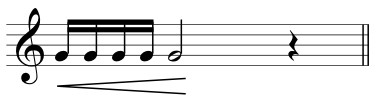
I do extended lite for about twenty minutes, frequently stopping to rest my right arm. After this, I move on to very short speed bursts, beginning at 120. Here I play at a more normal dynamic level. But I’ve added a wrinkle that I hope will better sensitize me to excess tension. I’ve noticed that when I do speed bursts, they almost always sound like this:
 ...getting louder through the burst. This, of course, means my hand tenses up through the burst, something I want to avoid. Thus, I try to maintain an even volume through the burst, or even decrescendo—then my hand won’t tighten up. So this is what I’m shooting for each time I work on short bursts. If I can gradually eliminate this tight sensation, then I hope eventually I’ll be able to double or triple the length of these bursts. This would bring me closer to extended alternation up to 184 with a relaxed hand.

When I first began doing extended lite work followed by speed bursts, there was always a clear distinction between the two—one felt completely different from the other. That’s not good. But over the last week, I’m feeling more of a segue between them. It helps that I’ve lately been able to begin my extended lite work at 92. By the end of it, I’m at 112, which isn’t far from the 120 tempo at which I begin speed bursts. More and more, the feel I have at the end of my extended lite work is similar to the feel when I begin my speed bursts at 120. This is exactly what I’m aiming for. As much as possible, I want my hand to feel pretty much the same at a wide range of speeds. Only at the extreme limit of speed would my hand begin to feel tight.

I’m still better at speed on basses rather than trebles. But the third string is starting to feel a bit more hospitable. I’ll keep at it.

On the bright side, I’ve breached several more barriers during the week. On Monday morning at 8:39 I hit a short burst at 192. (Yes, I really did write down the time. Humor me.) Five minutes later I hit a short burst at 200. By the way, 200 is so damned fast that after I hit the burst, I sat quietly wondering if I’d really done it. It took me a minute to convince myself that I’d actually done a burst at 200. Maybe I need what they have at hockey games: a light and klaxon that go off whenever I accurately hit a high speed burst.

And on Thursday morning at 7:58, I hit a short burst at 208. Hey, since my metronome only goes up to 208, maybe I can declare victory and close down my project.

On the bad side, I may have to delay my promised end of September video performance of the Mudarra Galliard. The problem right now is that there’s almost no spillover from my technique work to my normal playing. What I can do in the laboratory doesn’t work in the rough and tumble world of real playing. For the moment, I’m okay with that. This new approach seems to be getting somewhere, and I’m willing to change the game plan and ride it wherever it may go.

But I’m determined to prove I can hit a short burst at 200. So that will be my new end-of-the-month video goal.

——[My next update will be September 19, 2011]——

Saturday, September 3, 2011

September 3 Video Update

When the Philological Society of London decided in 1857 that a new English dictionary was needed, it was estimated that it would take about ten years to complete. This was a tad optimistic. The work that culminated in the Oxford English Dictionary took over seven decades to complete.

Closer to home, I probably underestimated the immensity of my project.

Here’s a sobering line of thought. Reading a book about neuroplasticity, I encountered the assertion that mastering a physical skill might take some 100,000 repetitions. Such assertions necessarily are approximate, of course, and beg the question of how anyone knows this to be so. But let’s take it as a given. Doing some quick ciphering, I can do 2400 reps in an hour—that accounts for non-rep time devoted to strength and conditioning, taking rest breaks, tuning the odd recalcitrant string, and stopping to investigate a mysterious crash caused by a curious cat. This works out to 100,000 reps in, according to my calculator, 41.666667 hours. (Love those irrational numbers.) So working an hour a day five days a week, it would take roughly two months to master a given skill. That in itself is daunting.

On top of that, however, my quick cipher ignores limiting factors. For example, those repetitions can’t be mindless—rather, they must be purposeful and carefully controlled. And I can concentrate only for so long in one sitting. That in itself limits the number of reps I can do in any one session. Further, my right hand project isn’t merely one skill. It’s actually a constellation of interlocking skills, each of which needs its own time and attention to master. Thinking this through realistically, it’s easy to see how my little project balloons exponentially.

On the bright side, when a man’s reach exceeds his grasp, he’ll at least be everlastingly engaged in interesting work. So I’ll always have a reason to get up in the morning.

My end of August (or beginning of September) video report is up and running. Rather than jabber endlessly on camera, I’ve opted for a Marcel Marceau document of how I’m currently working on rest stroke alternation. Though there are other things I do during my morning sessions, the video concentrates on the bulk of what I’m currently doing. Enjoy.


——[My next update will be September 12, 2011]——