Total Pageviews

Sunday, December 18, 2011

Hiatus

‘Tis the week before Christmas, and I’m goldbricking. My right hand practice sessions have been sporadic. Frankly, I think I’m suffering a temporary burnout. So I’m shutting down this blog for two weeks. I’ll come back to the task with a renewed spirit in January. Perhaps the new year will bring better things.

But lest you think I’m down, allow me to review the last week or so. A week ago Saturday, I performed with two of my young students in a recital—one of them did his first performance in front of an audience. On Monday, a thirteen year old student of mine played for a masterclass at the Cleveland Institute of Music run by graduate students of Jason Vieaux. She performed Villa-Lobos Etude 8, and I’m told she did very well. (I couldn’t be there, as I was working that evening.) On the same day, I learned that one of my adult students was selected to perform for a Vieaux masterclass in January. (I sent him and e-mail saying that if he played well, he might get a full ride to the Curtis Institute of Music. He wrote back that he always appreciated my sense of humor.) Tuesday I had a group of six beginners perform for an audience of over 1000 people at a Catholic School where I teach. In a delightful coincidence, I found afterward that at the same moment I was onstage with my students, a former student of mine was doing her Master’s recital at the Peabody Conservatory. Saturday I went to Guitars International to help my thirteen year old student select her first handmade guitar. With her new Vazquez-Rubio spruce top in tow, she, her father and I then had dinner at a nearby restaurant and discussed her future, as she’s recently decided that she wants to pursue music as a career. This morning one of my students and I performed for a Christmas program at his Baptist Church. (If you want to get your blood going on a cold Sunday morning, a Baptist service will do nicely.) And tomorrow morning I’ll visit the school of a first grade student of mine, where he and I will play for his music class.

All in all, it’s been a good week and a half. Times like this remind me of why I love my job. I wouldn’t trade it for anything, though I might trade my paycheck for that of a hedge fund manager.

Merry Christmas to all, and I’ll see you in 2012.


——[My next update will be January 2, 2012]——

Sunday, December 11, 2011

The Nitty-Gritty

During my student years at the Cleveland Institute of Music, I recall a class in which a student had just played. In this performance, there was a passage that recurred several times. Each time the player flubbed it. The teacher then asked the player about that passage. “Yeah, I have trouble with that part,” said the student. The teacher asked him what was the problem. “I just keep missing it,” replied the student. The teacher asked him again what was the problem. “I don’t know, it’s just always been a problem,” replied the student. This went on for a few more rounds, the teacher asking what the problem was, and the student giving vague replies.

Finally the teacher explained that the student needed to be far more specific. It wasn’t enough to merely acknowledge a problem. To solve it, the student first needed clearly define it. Was it a right hand fingering problem? Was it a left hand fingering problem? Was it a memorization problem? Until he did this, he was likely to keep repeating the problem. Short of clearly defining the problem, it wasn’t going to solve itself.

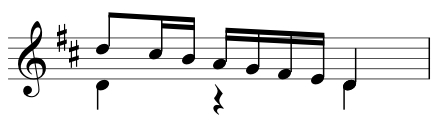
So this last week, where I tried to tweak the Mudarra Galliard up to 80, I also tried to drill deeper into the mystery of why anything at 80 or above wasn’t working. What I found was that I had to pay attention to more nit-picky things.

The Galliard has four separate passages with sixteenth notes. Each is different from the others. The first passage is thus:
For me, the main problem is a smooth and easy cross from the second string to the fourth string. Pivoting from the elbow alone doesn’t work for me. I find I must float my right forearm so that it barely touches the guitar, moving from both the elbow and shoulder. I also must coordinate the crossings so that my right hand fingers are precisely set for each string. I can’t tell you how many times I’ve swung and missed a note on the fourth string.

The second sixteenth note passage is thus:
This is the only passage on which I don’t use rest stroke. While the right hand fingering is a tad tricky, it usually causes me no problems. That’s not surprising, as I’m more comfortable with free stroke, and there are no big string crossing issues.

The third sixteenth note passage is thus:
Here all the notes of the scale passage are on the first two strings. I can post my right hand thumb on the fifth string, and everything goes fine. This is the passage I can hit must consistently.

Here’s the last sixteenth note passage:
This, of course, is the longest scale passage. And it’s the one that, more than the previous three, keeps me from comfortably playing the Galliard at anything above 80. As I wrote in my December 4 post, I need to be precise about where I place my right hand thumb during this passage. But drilling deeper, I found more. In a fast passage of some length, I must constantly be aware of a build-up of tension in my hand. Practicing this passage slower, I decided to take advantage of the natural breaks. At each eighth note, I relaxed my right hand before going on to the sixteenth notes, consciously letting my hand “go dead” in the instant before playing the following sixteenths.

This is an application of something I’ve learned to preach to my students over the years. I call this idea “micro breaks.” In it, the guitarist constantly tries to find moments within a difficult piece in which he or she can relax either hand. Rather than unthinkingly allowing tension to grow during a long performance, the player instead pins down every little place where either hand can release tension, however fleeting that instant of relaxation might be.

This is hardly a secret among good players. Some years ago I attended a recital by Raphaëlla Smits. During a particularly difficult piece, she came to a passage where she briefly played an E minor arpeggio on open strings. During this moment, she let her left hand fall away from the fingerboard and briefly stretched her fingers, as though relaxing her hand. The gesture was short and unobtrusive, so as not to distract the audience from the music. But to a player, the purpose of this movement was obvious: it allowed Smits an instantaneous break to relax her left hand. I’m willing to bet this was something she’d consciously practiced when learning the piece. I’d also bet that this was merely the most obvious example of something she does many times within a long and difficult piece.

During this project, I’ve occasionally been told that I think too much. “Let go,” I’m told, and just let let my natural instincts take over. But for one involved in remaking oneself, this is bad advice. When it comes to my playing as it is, my instincts are wrong. My instincts must be torn down and rebuilt.

Renovation is harder and more time-consuming than building from scratch. Boy, can I tell you a thing or two about that.


——[My next update will be December 19, 2011]——

Sunday, December 4, 2011

December 4 Video Update

As promised, below is a performance of the Mudarra Galliard for my monthly video report. As you’ll see, it’s at a fairly slow tempo. But for now, I don’t feel comfortable with right hand alternation at anything above 80. My goal for the Galliard is 100. I’ve tried that a few times during my morning practice sessions. It’s just not there yet.

On the plus side, I’m pleased that I made this video in one take. I did a ten minute warmup session, and then turned on the camera, fully expecting my first take would be a disaster. Instead, I got what you’ll see. That’s encouraging, because throughout this project I’ve found that what I work on during my morning practice sessions seldom translates into something I can reliably do in normal playing. Mind you, I’m not dancing in the street over this—it’s a slow performance, only three-quarter speed of what I want this piece to be. Nonetheless, it’s nice to see all this work starting to yield some improvement when the pressure is on.

During my morning sessions, I’m starting to notice that string crossing is becoming more of an issue. For example, I now find that if I don’t precisely plan where my right hand thumb is during certain passages, then my alternation isn’t smooth and easy. For example:
At point A, my thumb rests on the fifth string, and this keeps my hand stable and relaxed as the scale stays on the first and second strings. At point B, however, my thumb between bass notes must float freely above the strings—if it doesn’t, my hand tightens up as I come to the one third string note in the scale.

Further, in this passage:
...I must cross from both the shoulder and elbow rather than the elbow alone. If not, my hand tightens as I cross to the third and fourth strings. So in any right hand alternation on more than one string, I’m being very careful to monitor anything that increases right hand tension.

•                              •                              •

Friday night I had the pleasure of hearing Matt Palmer in recital. He’s a young guitarist who’s been making a splash lately with the three finger approach to right hand alternation. He’s also written a method book on this, which I’ve mentioned in my blog. Unfortunately I had a gig that night, so I was only able to catch half of Palmer’s recital. But what I heard confirmed my favorable impression from his videos. He’s a very fine player, and his scale work is impeccable. Indeed, I think the right hand three finger approach to scales will become standard technique within the next generation of players. And I think Palmer’s example will do much to push this along. His scales are so clean and supple that any reservations about the three finger technique will melt away upon hearing him.

Palmer’s bio and interviews always seem to dwell on his early years as an electric guitar shredder. I find this unfortunate. It suggests that one should expect machine-gun scales and bad tone from Palmer. But this isn’t at all how Palmer sounds. Rather, he’s a tasteful player with an excellent ear for tone and color. I spoke to him briefly during the reception, and found him to be a thoughtful and down to earth person. If you have a chance to hear him, do so.

Palmer is a tough act to follow, but here’s my video anyway. Enjoy.


——[My next update will be December 12, 2011]——

Sunday, November 27, 2011

Mother Nature Didn’t Kill Me—Yet

The cold is gone, and I’m back on my feet. That which did not kill me made me stronger, or at least restored my ability to type. So let’s pick up some loose ends.

First, I want to point out something that I keep forgetting to mention in my posts. For the last two months I’ve been doing the kind of practice that, in years past, forced me to stop because of right shoulder pain. Yet this time around the pain, though slightly noticeable, is nowhere near what it was in the past. In fact, the reason I kept forgetting to mention it is that it’s so slight that I barely notice it. This encourages me. At the outset of this project I said I’d use this pain as a barometer of how well I was doing. More pain means I’m on the wrong track—less pain means I’m on the right track. I believe the approach I described in my October 30 post is mostly responsible for my freedom from pain.

Second, I’ve been mulling over a comment I received on my February 12 post. The more I think of it, the more I agree with the advice that I should rebuild my right hand slowly and patiently. Next week, for my end of the month video, I plan to perform the Mudarra Galliard. It won’t be at what I regard as a good performance tempo. Rather, it’ll be a baseline for my (I hope) future progress.

Short report this time, as I need to put the finishing touches to a letter of recommendation for one of my former students. Since Christmas is approaching, I thought I’d end this post with a video this former student and I made a few years back. She was sixteen at the time. Today she’s working toward her master’s degree in guitar performance. Geez, time flies. Anyway, enjoy. (And please, no comments about my old right hand position, as I’ve improved it since then.)

Sunday, November 20, 2011

On Sick Leave

Been down with a cold the last few days. Assuming I recover, I’ll be back up and typing away on November 27.

Sunday, November 13, 2011

Gold and Dross

Sometimes it’s illuminating to put my posts out there and then stand aside to watch the responses. Here, for example, is one response to my November 6 post:
I totally agree with your view that vague advice about attaining speed such as just “play slow” won’t help the student. But I think you had bad luck or [little] experience with guitar teachers, because none of the teachers I’ve had would say only those simple vague words. All of them were very specific on what to work on during slow practice that would improve my technique when playing faster. Including breathing and several other things about body and mind attitude, besides obvious guitar technique such as good hand positioning, nail shape, and so on.
I’d like to think the teaching described here is true everywhere. But my November 6 post also brought this reply:
One of the best unknown guitarists I have ever heard used to breathe so loud, but that guy could play like nobody’s business. He had a very relaxed, virtuoso technique.  Does it really matter that he was a loud breather? I never cared. Perhaps some people are loud and can’t do anything about it?  I have had my nose broken multiple times. I can’t deeply breathe without being loud.

As for your blog, you mentioned it being pointed out that your fingers are more extended when alternating on a string. Your hand position was one of the 1st things many of us mentioned to you here. Your RH fingers weren’t curbed and didn’t move in a fist like motion among many other things.

These questions are straight forward.

How slow is slow? As slow as it takes to think about the next note. Thinking one note ahead.

How long should one practice slow? Until you can play the piece at a tempo where you don’t make any mistakes and can think at least one note ahead.

How gradually should one increase the practice tempo? See above and Slow/Fast practice. One measure/phrase, etc played perfectly slow, then immediately practiced at tempo.
So on the one hand, the first reply says the things I mentioned in my November 6 post—among them, labored breathing as a sign of excess tension—are common knowledge. On the other hand, the second reply dismisses labored breathing as a sign of an underlying problem. It also encapsulates my argument that not enough is being said to those of us who lack right hand speed. There’s not a word suggesting that one should look for an underlying cause that might hinder right hand speed. In essence, one plays slow until one can play fast.

And over four decades of playing, that’s not yet worked for me. Nor has it worked for many others.

Okay, I don’t wish to read too much into what may be an off-the-cuff response on an internet forum. I’ve no doubt that the guitarist who wrote the above quote knows physical and psychological impediments can hinder speed. (The guitarist who wrote this is both a teacher and an accomplished player.) But I wonder why he chose to refute my contention that labored breathing is a sign of excess tension. Is there really any argument about this? All things being equal, isn’t it obvious that one who’s breathing heavily is less relaxed than one who’s breathing normally?

Indeed, throughout my project and the discussions it has prompted, I’ve been surprised at some of the arguments against things I thought were common sense. It seems among some there’s a philosophic distaste for proscribing anything if a seemingly good argument, however tenuous, can be made for it. It’s much the same mindset that permeates American politics, in which it’s hard to argue against something if it’s portrayed in a positive light. “Pro-life” for example—who could be against that? Or “pro-choice”—who could be against that? Well, this isn’t so surprising, since everyone wants to cast their argument in the strongest possible way.

More subtle, however, is the notion that in proscribing a thing, one is necessarily less open-minded than one who defends it. Obviously every case must be judged on its own merits. But I reject the idea that because a thing is minimally defensible, it’s thus not to be proscribed. An open mind doesn’t mean one must accept every idea that washes up on the beach.

I’m sorry, but I can’t accept advice that’s never worked for me. Nor can I be satisfied with advice that’s good as far as it goes, but doesn’t go far enough. Something more is needed. That’s what I’m looking for.

——[My next update will be November 21, 2011]——

Sunday, November 6, 2011

Catcher in the Rye

First, let’s clear up a minor mystery. Remember how, in my October 30 video, my little finger splayed out when I did the drumming on the soundboard? And recall that it didn’t do this when I began alternating on a string? The reason, I found, was that when drumming, my fingers are more extended than when they’re alternating on a string. If my fingers are a bit more curved, the little finger is more relaxed and more apt to move with its neighboring fingers. Duly noted, and I’ll work that tidbit of information into my right hand work.

This week I exchanged e-mails with a very fine guitarist who’s been following my project. While very encouraging overall, he did respectfully disagree with me on a particular point. I’d written the following:
“In my experience, much of the advice about attaining speed is too vague. Some players will get it, but most don’t. I suspect that many of the players who do get it have the physical knack, or they have the mental knack for figuring things out for themselves and the discipline to apply what they’ve figured out. In short, I believe many who get it do so through their own effort, and not necessarily because of specific and effective advice.”
The guitarist I corresponded with disagreed, replying that all the high level players he’s talked to are consistent in what they say: one must begin with patient and slow practice. During this slow and deliberate practice, one must emphasize relaxation, combined with lots of successful repetitions.

All true. And some players who are told little more than this will do very well. But I still think that, for most players, this isn’t enough. We need something more. It’s not enough to be told to practice slow. It’s not enough to be told to emphasize relaxation. The vast majority of serious guitar students do precisely that and get nowhere in regard to right hand speed. Why? Because, I believe, they aren’t told specifically enough what it is they’re supposed to be working toward.

Let’s take slow practice as an example. As any experienced teacher knows, “slow down” is probably the single most frequent advice we give to students. (I’ve joked to my students that I could save myself a lot of breath if I just had “slow down” tattooed on my forehead.) But what do we really mean by this? How slow is slow? How long should one practice slow? How gradually should one increase the practice tempo?

Instead of telling a student to practice slowly, we should instead focus on something more tangible. Consider, for example, saying this to a student: “Can you play this passage without labored breathing?” If your breathing is labored, then you’re more tense than you should be. So slow down. How slow? Until your breathing is no longer labored.

There’s a subtle but important difference between this and merely telling a student to practice a passage slowly until he masters it. If I tell a student to practice slowly, then slow practice becomes an end in itself. The student simply does it until he improves by sheer chance, or fools himself into thinking he’s improved, or gives up in frustration. But if I tell the student to focus on his labored breathing, he becomes more aware of a tell-tale symptom of excess tension. He slows down until the labored breathing ceases, which neatly answers the question of how slow he must go. How long should he practice slowly? Until he can accurately and consistently play the passage while breathing normally. How gradually should he increase the tempo? Exactly as fast as he can increase the tempo without a return of the labored breathing.

Here are some specific things we should be telling students repeatedly:
  • Good technique should be easy. If you can’t do a particular technique easily, accurately, and consistently, then you don’t have good technique. Assuming you’re practicing consistently and intelligently, technical excellence should be something that’s always there, not something that comes and goes.
  • Labored breathing is a sign of excess tension. It’s not a sign of interpretive excellence, nor is it a sign that you’re more musically committed than other musicians. It only means you’re working harder than you should to put across your musical ideas.
  • In all aspects of playing, be alert to those little shots of nervousness—they feel like tiny jolts of electricity. If you consistently feel this in a particular passage or technique, then you’re too tense.
  • If you’re trying to change deeply ingrained bad technique, there are no quantum leaps. You must proceed in tiny steps. If you try to overreach, you’ll slide right back into the deficient playing you’re trying to overcome.

Some might object that I’m saying nothing new here. Perhaps. But look around. Is the kind of specificity I’m advocating really the norm? Are teachers really insisting on these things, so that excess tension is something every well-trained and ambitious student understands in all its ramifications? Consider the following video:


Skip ahead to the 4:50 mark, where these two players trade fast scales during a cadenza. If you listen closely, you’ll hear which player has the easier technique—it’s obvious. It’s also obvious that the player who’s working harder has never understood that excess tension is something to take seriously.

If you think I’m picking on someone whose playing I don’t care for, then consider Julian Bream. I regard Bream as the greatest guitarist of the 20th century. I yield to no one in my admiration for him when he was at his best. Indeed, whenever I have a young player who begins to show potential, I always make sure he or she hears recordings of Bream in his prime. To my mind, one can’t fully know what the guitar can do without hearing Bream.

That being said, I’d never use Bream as a model for good technique. Bream, I think, is an example of how artistic genius can overcome flawed technique—for a while. He’s also an example of how even the greatest artist inevitably can be felled by flawed technique.

•                              •                              •

What is a teacher if not a catcher in the rye? One might find solace in an “I’m okay, you’re okay” attitude, thus sparing one from the danger of weighing one’s own ideas and finding them wanting. But if we’re to be something more, then we must know the value of what we teach. And we must insist on it in the face of ignorance or apathy. If we know with sufficient clarity what should be emphasized, and we pass it on with conviction and imagination, then we might spare others the sad fate of diminished potential.

Who knows—Holden Caulfield might’ve made a good guitar teacher.


——[My next update will be November 14, 2011]——