Total Pageviews

Saturday, February 25, 2012

February 25 Video Update

This was the week I decided to get something above 90 on video. Monday was a day off from work, and I decided to make a video of the Mudarra Galliard. That morning during my right hand practice session, I’d hit the Galliard at 92. So that afternoon I set up the camera and warmed up on the guitar. Then I’d run a few takes, pick the best one, and upload it. Piece of cake.

I turned on the camera and played for about ten minutes. When I thought I had some good takes, I got up to turn off the camera. It was then that I noticed it wasn’t recording. Dammit! Examining the camera, I found it had recorded for a few minutes, then shut itself off. Did I have too many old files cluttering up the memory disk? Thinking this was the problem, I deleted every old file I could find. Then I started again. Looking up at the camera between takes, I found it again had shut itself off after a few minutes.

Great. Now I apparently had a defective camera that would run for only a few minutes. I again deleted the recording I’d made—there was nothing good enough to keep—and started over. I began running through the Galliard knowing that the camera would stay on for only two or three takes. This made me edgy. My playing devolved as my anger increased. Finally I gave up. It wasn’t going to happen on this particular day. I broke down the camera gear and put away my guitar. To cool down, I took a walk.

Mulling this fiasco as I walked, I saw that I’d let my emotions sabotage my playing. I couldn’t allow this to continue. To develop a consistent technique, I needed to better control my reactions to bad circumstances. After all, concert artists constantly have to deal with less than perfect situations: bad halls, noisy audiences, broken nails, strings that refuse to stay in tune, et cetera. The best artists make the best of it and play well. The bad ones pitch a fit and play badly. While I’m no concert artist, I’d like to model myself on what the best concert artists do. And I don’t want the quality of my technique to depend on however I happen to feel at the moment.

Tuesday, I took another crack at making a video. Knowing the camera would give me only a short window of opportunity, I decided to run takes of the scale section of the Galliard. I wasn’t yet ready to hold my emotions in check for the entire Galliard, so I’d leave that for another day.

The result of this session is on the video below. The first take on the video is at a metronome setting of 92—the second take is at 94. I did five takes at 92, which explains why you’ll see me say “that was five” on the video. The fifth take wasn’t the best, but it was right before the good take at 94, and that’s why I used it.

My next goal is obvious: get the entire Galliard on video, preferably at my target tempo of 100. I’m working on it.

By the way, there’s nothing wrong with my camera. Turns out it had a lot of old files that didn’t show up on the camera display, but did show when I hooked it up to my computer. I deleted the old files. So the next time I try to get a good performance on video, I’ll have more than a few minutes to get it. That should improve both the quality of my playing and my blood pressure.


——[My next update will be March 4, 2012]——

Sunday, February 19, 2012

In Praise of the Metronome

My alternation in the 80’s seems well established, so I’m gunning for the 90’s, with an occasional foray into the 100’s. At the end of this month I’d like to have a video of the Mudarra Galliard at 92. But getting this on camera will be like trying to catch a glimpse of the Lock Ness Monster. To get it on video, I’ll likely need to do many takes. I’ve considered doing some of my morning practice sessions in front of the camera. Then if lightning strikes, it’ll be on camera.

Technical progress is a shape-shifting thing. It often comes in stages. First, I can’t do it at all. Then I begin work, barely knowing exactly what I’m doing, but trying things I’ve been told by others. If I’m lucky, there comes a brief flash when I almost do it—of course it flits away immediately, but now I’ve the tiniest window into the correct feel of what I’m trying to do. That encourages me, and I soldier on. Next, I get to where I can do it, but not consistently, and certainly not in front of an audience. Again, I soldier on. In time and with a lot of hard work, I have in hand something that moves me forward as a player.

None of these stages are clearly discrete from one another. In fact, there’s seldom an “eureka” moment when I obviously cross from can’t to can. Rather, it’s more like one day I stop and say: “Wait a minute, didn’t this used to be impossible for me?”

As I run repetitions above 80, I’m more and more trying to simulate a performance mindset. Rather than endlessly running repetitions one after the other, I’m treating each repetition as an individual performance. I’m trying to recreate the “one and done” reality of guitar playing. A technique that crumbles under pressure is worthless. So it’s time to ratchet up the pressure.

I’ve also begun adding a modest collection of right hand studies at the end of each session. Brouwer’s Nos. 6 and 7 from Estudios Sencillos make an appearance, 6 for arpeggios, and 7 for string crossing. (I also like 7 for its weirdness—it sounds like music from another planet.) A couple of Giuliani studies are in there, and also Carcassi’s Op. 60 No. 7. And sometimes I top it off with Villa-Lobos Etude 1 and the Carulli Fandango.

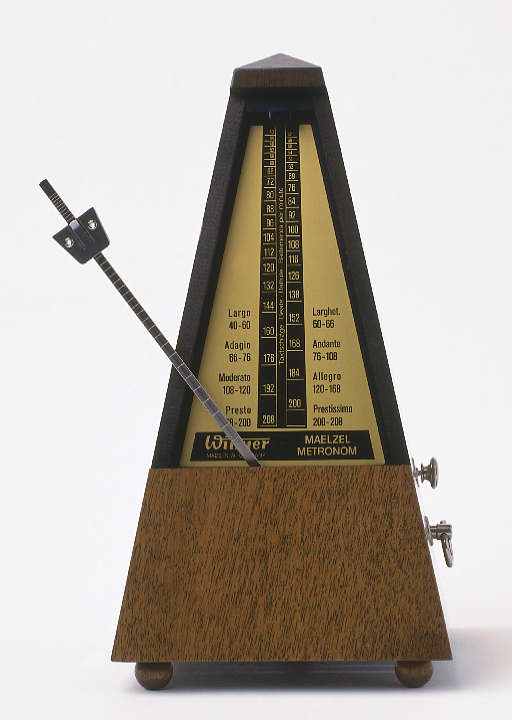
I’d like to close with a defense of the much maligned metronome. From time to time during my project I’ve been advised to ditch the metronome. I find such advice odd, particularly coming from musicians, and especially coming from guitarists. There often appears a fundamental misunderstanding of what the real value of a metronome is for a practicing musician.

First, I’d like to dispense with an argument I’ve seen repeatedly. It’s illustrated by the following exchange, where I wrote:
“Really, there’s no fundamental difference between keeping up with an orchestra and keeping up with a metronome.”
...which prompted this reply:
“There is a fundamental difference, otherwise we would be happy with computers playing everything without those annoying mistakes humans make in live performances. The metronome may have a pulse but it doesn’t breathe.”
Try as I might, I can’t understand why someone thinks any musician needs to be told this. Yes, the metronome is inflexible. That’s not a secret—everyone who uses a metronome knows it. To tell a musician that a metronome is inflexible is tantamount to saying that you’re talking to an idiot who can’t tell the difference between a tempo set by a living orchestra and a tempo tapped out by a machine. That may be so. But isn’t it more charitable to assume that the musician you’re talking to perhaps has something less idiotic in mind?

Which brings me to my main defense of the metronome. I don’t see the metronome as something that teaches me how to keep a steady tempo. It may, but that’s not its real value. Its real value is that it trains me to be objective about my playing. Rather than relying on my internal and subjective sense of tempo, the metronome forces me to attend to something outside myself. I must match my playing to something that cares not a whit for my problems in executing a particular passage or technique. Either I can do it, or I can’t. The metronome immediately tells me. There’s no negotiating, begging, or wheedling with it. And that’s what I mean when I say there’s no fundamental difference between keeping up with an orchestra and keeping up with a metronome.

Speaking of the metronome, I once attended a performance of György Ligeti’s Poème Symphonique. For those unfamiliar with it, this is a piece in which 100 wind-up metronomes are set a-going. The piece ends when the last metronome stops. While I might quibble with its definition as a musical work, I must admit it was an oddly mesmeric spectacle. I also recall that some in the audience were taking bets on which metronome would be the last to run down. In my opinion, Ligeti missed a potentially lucrative opportunity to exploit this aspect of his composition.


——[My next update will be February 26, 2012]——

Saturday, February 11, 2012

Believing Is Halfway to Doing

This has been another good week. On the Mudarra Galliard, I’ve been hitting 80 pretty reliably. On Thursday I hit it cleanly at 92, something I’ve never done before. Whether I can hit it under pressure is debatable. I’ll try to get it on camera at 92 by the beginning of March. So 2012 is being good to me so far. Maybe even numbered years are my friends.

I wouldn’t say that 2011 was a total washout. If nothing else, it’s made me intimately familiar with the tension that inhibits my right hand speed. Indeed, on any given day I can pinpoint exactly where the cutoff is that delineates my relaxed hand from my tense hand. This week, for example, 80 was no problem for my right hand rest stroke alternation. I felt relaxed, and my playing was clean and accurate. At 84, I could still manage it, but I could feel the tension beginning to brew along my shoulders and creeping up my arm. At 88, the tension hit the tipping point to where I could no more reliably do alternation. On any given day, these numbers can vary. But this is now how precisely I can gauge what I can do.

Counter-intuitive as it may be, this is a good thing. I can’t change what I don’t know. If this tension went unnoticed, I’d be hard-pressed to work at eliminating it. But now I know it well. And knowing it, I’m well on the road to resolving it.

With a foothold on 80 well in hand, I’m now aiming for the 90’s. I’ve noticed that when I try alternation at 92, the 80’s seem easier, even if my try at 92 didn’t go well. It’s all part of my determination to expect success. Call it the Tinkerbell Theory: to fly, I must believe. Certainly there’s nothing gained by pessimism. If I don’t believe I can do something, then I’m already halfway to not doing it.

This week I got a telling demonstration of how attitude influences technique. While running the Galliard at 92, I had a brief lapse of concentration and botched the left hand fingering halfway through an extended scale passage. While the botch was brief, it triggered a flash of anger—with that anger my hand, which until then had felt reasonably relaxed, suddenly tensed up and butchered the rest of the passage. Stopping for a moment, I made a mental note to heed the lesson my body was trying to teach me. Overreacting to mistakes inhibits technique.

So grow up and stop pitching a fit whenever something goes wrong.


——[My next update will be February 19, 2012]——

Saturday, February 4, 2012

Practicing Under the Drill

This was a surprisingly good week. First, I was able to pretty consistently hit the Mudarra Galliard scales in the 80’s. More importantly, I cracked 90 with a few good performances.

Part of the reason, I think, is that I’ve started to attack my lengthy warmup problem. As I’ve reported in the past, it takes far too long to get my right hand up to speed. So I’ve begun each session this week by trying to get my alternation speed up to 80 within ten minutes. I’ve long suspected that much of what we attribute to a need to warm up is actually more psychological than physical. In other words, instead of a physical warm up, I need to be quicker and more deliberate about snapping my concentration into focus.

Some years ago I got a glimpse into how quickly a concert artist can shift into performance mode. Before Jason Vieaux became as busy as he is now, I sometimes played duet gigs with him. One of these gigs was a summer outdoor party. Because we were background music and no one was paying close attention to us, Vieaux would occasionally cut loose and improvise rather than follow what was written in his part. Doing so, he’d sometimes flub a note or two—nothing horrible, but flubs nonetheless. After finishing one piece, he’d apparently flubbed one note too many. I heard him mutter to himself “okay, stop fooling around.” As we began the next piece, it was like he’d flipped a switch and gone into full-bore concert artist mode. Every note was clean, and every rhythm was crystalline. I recall thinking that this is what it’s like to play alongside a world class concert artist. (I also recall thinking that I’d damned well better keep up.)

Clearly, attitude is half the battle. So part of my practice sessions are now devoted to improving my attitude toward speed. Rather than viewing speed as a far-off goal, I’m instead cultivating the mindset that I fully expect to do this, and also that it shouldn’t take long to warm up my right hand. This by itself seems to be paying off right away. I’ll keep at it.

In keeping with my goal to change myself, I’m now experimenting with relaxation in situations other than guitar playing. This week I had two visits to the dentist. When the drill is bearing down into my back molar, my tendency is to white-knuckle my way through the experience. What better time, I thought, to practice consciously relaxing myself. While my success in doing this varied—I’m not intrinsically stoic—it’s in keeping with my gradually increasing certainty that all is one. What I do without the guitar influences what I do with it.

Yes, one can improve one’s guitar playing even while cowering in a dentist chair.


——[My next update will be February 12, 2012]——

Sunday, January 29, 2012

Stuck At 80

Today was a busy day, so this entry will be brief. I’m now pretty consistent with i and m alternation at any tempo below 80. Past 80, things get dicey. On various days, the Mudarra Galliard has gone okay at 84, and sometimes even 88. But I wouldn’t trust it in a performance situation. And above 90, it just ain’t there.

All of this is only after a warmup of about ten or fifteen minutes. Starting cold first thing in the morning, I begin at 50 and rapidly increase the tempo. I dislike that I must begin so slowly, but my hand just isn’t there from a cold start. So it is what it is. It may be that I’ll never be the player who can pull the guitar out of its box, tune up, and then immediately rip a scale at 160.

Running open position scales across six strings, I’ve found that I can hit 100 on occasion. That’s nothing to throw confetti over. But it’s something.

The more I work on this, the more obvious it becomes that a good part of the barrier between me and speed is psychological. Whenever I try the Galliard at 90 or above, my hand, arm, and both shoulders tighten up. This ingrained tension, I’m convinced, is deeply rooted in my personality.

This reminds me of something I’ve noticed about profession auto racers. Back in the 1970’s, I was assigned by my college newspaper to get a photo of Janet Guthrie, the first woman to compete in the Indianapolis 500. To get a good action shot, I sat in the passenger seat as she drove through a slalom course. As the car was heaving from side to side, Guthrie was very cool and economical with her steering. Being relaxed behind the wheel is obviously a job requirement for a professional driver. Contrast this to a poor driver who freezes in a sudden emergency and careens off the road into a ditch.

People who freak out in dangerous situations make bad drivers. People who tense up when playing fast make bad guitar players. There’s no way around it. To become a better player, I must become a different person.

Saturday, January 21, 2012

I’m Back

Sorry for the delay. A family medical emergency came up. But things are taking a turn for the better, so I’m able to get back to my self-improvement project.

The first year of this project seems a blur of experimentation and unfulfilled expectations. Nonetheless, I’m optimistic for the new year. I can’t help it—I’m an incurable optimist. Which reminds me of the joke about the optimist who fell off a 100 story building. As he passed the 37th floor, he said to himself: “Well, so far, so good.”

Picking up where I left off, I’ve been running slowly increasing reps of the scale passages in the Mudarra Galliard. I start at a metronome setting of 50. I then creep up the metronome until I hit a wall. At the moment, that wall is in the area of 80. Encouragingly, however, on Friday I played the Galliard cleanly at 88, and did a passable performance at 92. Whether I could do that before an audience—or even for a video—is questionable. But progress is progress, so I’ll take it.

I should explain why I’m sticking doggedly to a single piece for so long. To me, it makes sense to have a piece so thoroughly familiar that the only problem with it is the problem on which I’m focused: right hand alternation speed. Nothing else about the Galliard is problematic, so it makes it easier to tease out whatever subtle things are preventing my right hand from gaining the speed I’m aiming for.

Over the past two weeks, I’ve decided to zero in on the following things during right hand alternation:

• Fingers should move very directly, both as they drive through the string and as they return for the next stroke. Under no circumstances should I allow the tension of the string to deflect my fingers from this direct flexion and extension. That means no sidepulls, and no riding along the length of the string.

• Take advantage of every opportunity for micro-breaks. Consciously release tension in my right hand at every opportunity, however brief.

• Be extremely precise with right hand string crossing. When crossing from one string to the next, be sure the finger is snug to the string on the very first note after the cross.

• Control anxiety as speed increases. I’ve noticed that when the speed goes up, so does my anxiety. I need to consciously break this vicious cycle. Tension caused by anxiety is just as real and debilitating as tension caused by bad technique.

• Don’t neglect left hand accuracy. When a left finger isn’t snug to the fret, it squeezes harder to avoid a buzzed note. That excess force can easily spill over to the right hand.

During every minute of practice, I want to work at deeply ingraining these things into my playing. If the first year has taught me anything, it’s that I must become a different person from what I’ve been in the past when playing the guitar. More of the same won’t get me where I want to go. I have to rewire myself both physically and psychologically.

I believe most people vastly underestimate how important and difficult this is. Imagine an emotionally unstable child trying to learn how to fly an airplane. You can teach him all you can, but in the end, you still have an emotionally unstable child flying an airplane. That won’t end well. The only way to improve the odds that the airplane won’t crash is to put someone else in the cockpit—someone older and more emotionally stable.

The old me has reached his ceiling on the guitar. So here’s to the new me, better than the old me. The only way to build a better right hand is to build a better man. And may he arrive soon.


——[My next update will be January 29, 2012]——

Monday, January 16, 2012

Notice

For those who are wondering why I haven’t posted anything this month, a family emergency has come up. But things should settle down by the end of this month. So I hope to be back on track soon, and am looking forward to making more progress on my project.

I apologize for the delay. By the way, I’m aware of the irony that my one year project is entering its second year.